

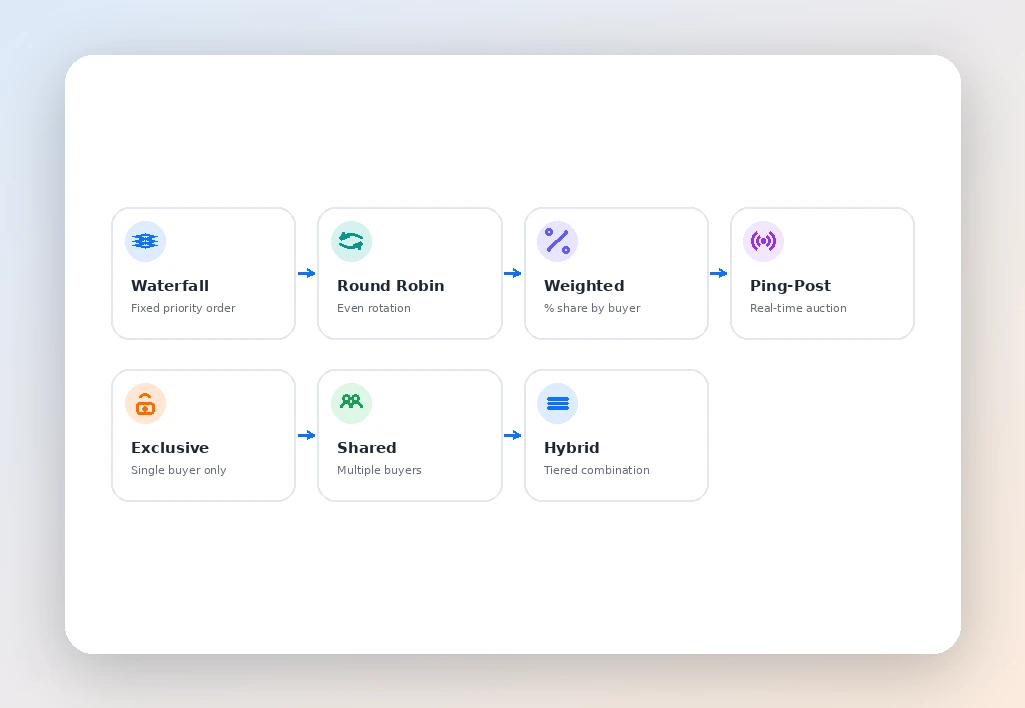
Every lead distribution system needs a routing model: a rule for deciding which eligible buyer gets a lead, and in what order, once buyer matching has already filtered the field. Get the model wrong for your buyer mix and you’ll either overload your best buyer, starve them of volume, or hand leads to buyers who convert them poorly. Here are the seven models worth knowing, what each one optimizes for, and when to use it.
1. Waterfall (Priority Routing)
Buyers are ranked in a fixed priority order. Every lead goes to buyer #1 first; if they reject, don’t respond, or are at cap, it falls to buyer #2, then #3, and so on down the list.
Use it when one or a small number of buyers clearly outperform the rest on price or conversion, and you want to protect that relationship by always giving them first look. It’s also the simplest model to implement and reason about, which makes it a sensible default when you’re just getting a distribution operation off the ground.
Watch for: a static priority list that never gets revisited. Buyer performance shifts over time, and a waterfall that isn’t re-ranked periodically quietly sends your best leads to a buyer who used to be great but no longer is.
2. Round Robin
Leads rotate evenly across a pool of buyers, one after another, regardless of price or past performance.
Use it when buyers in the pool are genuinely comparable in quality and you’re optimizing for a fair, predictable volume split rather than squeezing out maximum price. It’s common among networks with contractual volume commitments to multiple buyers.
Watch for: uneven buyer quality. Round robin has no concept of “this buyer converts better,” so if quality varies, it will cheerfully send volume to a weak buyer on their turn.
3. Weighted Distribution
Similar to round robin, but each buyer gets a percentage share instead of an equal turn: a top buyer might get 50% of volume, a secondary buyer 30%, and a third 20%.
Use it when you want several buyers active at once (for relationship or redundancy reasons) but still want more volume flowing to whoever performs best. Weights should be tied to a real metric (conversion rate, price paid, or a blended score), not set once and forgotten.
4. Ping-Post (Auction)
Instead of committing a lead to one buyer, the system sends a partial “ping” (enough data to price the lead, not the full record) to multiple buyers simultaneously, collects their bids or accept/reject responses, and posts the full lead only to the winner.
Use it when you have enough buyer volume to run a real auction and buyer economics vary lead by lead (some buyers pay more for certain states, verticals, or times of day). Ping-post typically extracts the highest price per lead of any model here, at the cost of more integration complexity on both sides.
Want waterfall, round robin, weighted, and ping-post routing available from one dashboard? Try Vertikl free for 14 days.
5. Exclusive Routing
The lead goes to exactly one buyer, with no fallback and no other buyer ever seeing it, typically because of a contractual exclusivity agreement.
Use it when a buyer relationship is structured around exclusivity, usually at a premium price to compensate for the buyer taking on 100% of that lead’s risk. It’s the simplest model of all, but it means a validation failure on the buyer’s end (a full CRM, a bad phone number, a compliance hold) is a fully lost lead with nowhere else to go.
6. Shared / Non-Exclusive Routing
The same lead is sold to more than one buyer at once, each aware they’re not the only recipient, usually at a lower per-buyer price than exclusive.
Use it when lead supply is scarce relative to buyer demand and buyers are willing to compete for the same prospect after delivery, common in verticals like insurance and legal. It raises total revenue per lead but requires buyers who have explicitly opted into shared delivery, since selling a lead as exclusive when it wasn’t is the fastest way to lose a buyer’s trust permanently.
7. Hybrid Routing
Most mature operations don’t run one pure model, they layer them. A common pattern: round robin or weighted distribution across a tier of comparable top buyers, with waterfall fallback to a secondary tier if everyone in the first tier rejects or is at cap.
Use it when your buyer base has a clear tier of comparable, reliable buyers plus a longer tail of secondary buyers you’d rather not use as anything but a safety net. Hybrid models take more setup than a single strategy, but they’re usually where a distribution operation lands once it has enough buyer history to know who really belongs in the top tier.
Choosing Between Them
The right question isn’t “which routing strategy is best,” it’s “which one matches the buyer mix I actually have right now.” A few starting heuristics:
- One dominant buyer, several backups → waterfall
- Multiple comparable buyers, fairness matters → round robin
- Multiple buyers, quality varies, all should stay active → weighted
- High volume, price varies lead by lead → ping-post
- Contractual exclusivity → exclusive
- Scarce supply, buyers compete post-delivery → shared
- Tiered buyer base with a clear top group → hybrid
None of these is a permanent choice. As buyer volume and quality shift, the model that made sense six months ago may not be the one that maximizes revenue today, which is why routing rules should live in a system you can adjust in minutes, not in a script someone has to redeploy.
Configure any of these seven routing models without writing code. Get started with Vertikl.
