

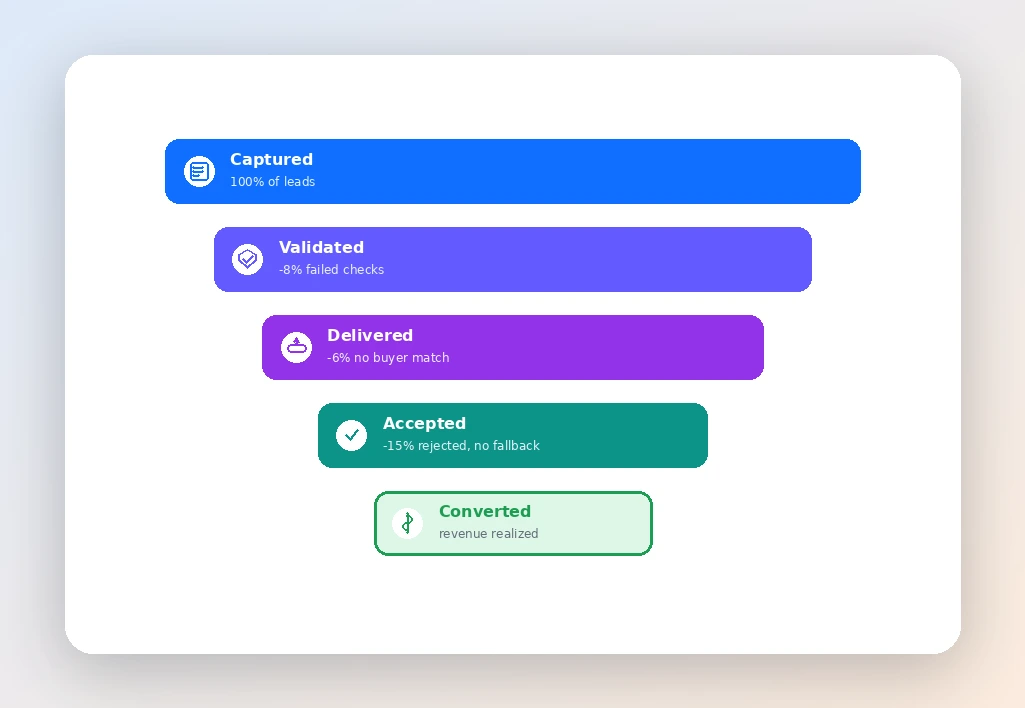
You paid to acquire a lead. It got captured, matched to a buyer, and delivered. So why does the revenue at the end of the month not match what it should? Lead distribution pipelines leak revenue at very specific, very findable points between capture and conversion, and most operations are only measuring one or two of them.
The Pipeline Has More Leak Points Than You’re Tracking
If you’re only watching “leads delivered” and “revenue collected,” you’re seeing the two ends of a pipe with several valves in between, any of which could be draining value. The five that matter most:
1. Validation Failure
Leads that never should have been sold in the first place: bad phone formats, duplicates, leads that fail compliance checks. If these are filtered out after being counted as “captured” but before being counted anywhere else, they quietly deflate your usable lead count without showing up as a clear line item anywhere.
What to check: validation failure rate as a percentage of raw captures. If it’s climbing, the problem is upstream, usually a lead source with declining data quality.
2. Buyer Matching Gaps
A lead that doesn’t match any buyer’s eligibility criteria (wrong state, wrong vertical, outside business hours) has nowhere to go. If this happens often, it means your buyer roster doesn’t actually cover the leads you’re generating, and no routing model can fix a matching problem.
What to check: the percentage of validated leads with zero eligible buyers. This number should be close to zero; if it isn’t, it’s a buyer sourcing problem, not a routing problem.
3. Rejection Without Fallback
This is usually the single biggest leak. A buyer rejects a lead, and instead of falling through to the next eligible buyer, it just dies. Every rejected lead with no fallback path is revenue you already paid acquisition cost for and collected nothing on.
What to check: rejection rate by buyer, and separately, what percentage of rejected leads have any fallback destination at all. If a meaningful share of your routing rules terminate at “reject = done,” that’s the leak to close first.
See exactly where leads are rejected and recovered in your pipeline. Try Vertikl free for 14 days.
4. Acceptance Without Conversion
A buyer accepts a lead, which looks like success on a delivery dashboard, and then never converts it. Acceptance is not revenue, it’s a step toward revenue. If you’re only tracking acceptance rate, a buyer can look great on paper while quietly converting almost nothing.
What to check: conversion rate per buyer, not just acceptance rate per buyer. If you don’t have this data, it means you’re not getting outcome feedback from buyers after delivery, which is a gap worth closing before anything else on this list.
5. Stale Routing Rules
Routing rules built around buyer priority, weights, or caps that made sense six months ago don’t automatically stay optimal. A buyer whose conversion rate has quietly declined can still be sitting at the top of a waterfall, absorbing your best leads and converting them worse than a buyer ranked below them.
What to check: compare current buyer conversion rates against your current routing priority or weights. Misalignment here is common and easy to miss because nothing about it throws an error, it just slowly costs money.
Finding Your Biggest Leak
Start with rejection rate by buyer and conversion rate by buyer, side by side. These two numbers, more than anything else, tell you whether the leak is happening before delivery (matching, validation) or after it (rejection handling, buyer quality). Most operations that haven’t looked closely find their single biggest leak is rejection-without-fallback, simply because it’s invisible on a “leads delivered” report and only shows up when you specifically ask “what happened to the leads that got rejected?”
Once you know where the leak is, the fix is usually structural rather than a one-off patch: add fallback routing where it’s missing, re-rank buyers by actual current performance instead of legacy priority, and require conversion data back from buyers as a condition of staying in the routing pool. None of that is possible without visibility into every stage of the pipeline, which is the part manual routing and spreadsheets almost never provide.
Stop guessing where revenue disappears between delivery and conversion. Get started with Vertikl.
