

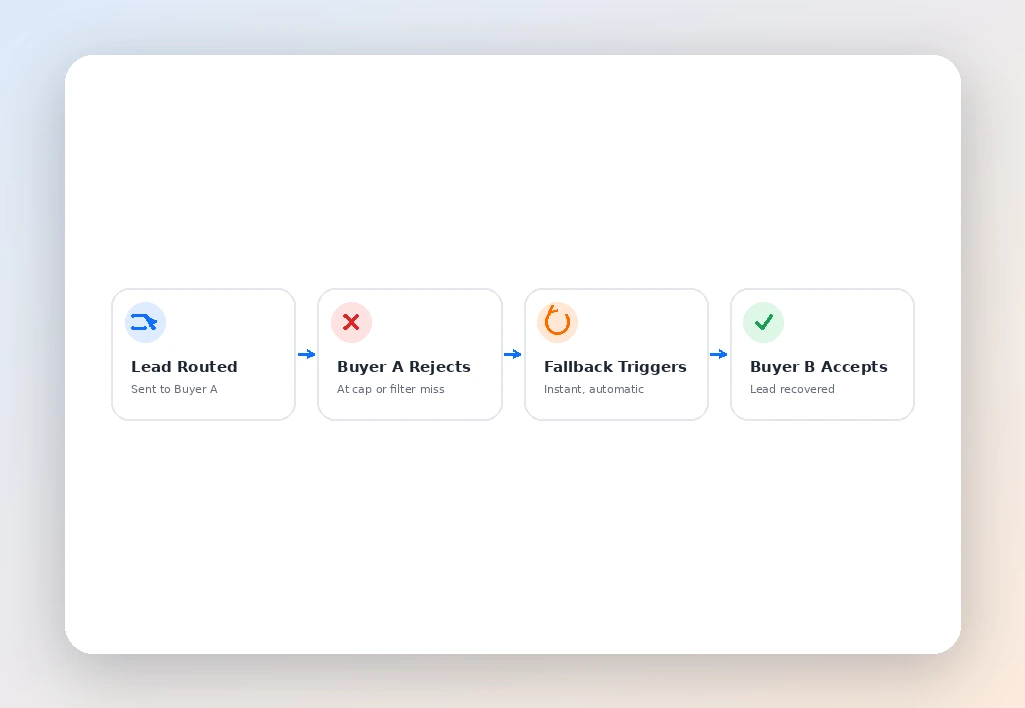
A rejected lead isn’t the end of the transaction, unless your routing setup treats it that way. Fallback routing is the mechanism that catches a lead when the first buyer says no and sends it, automatically and in real time, to the next eligible buyer instead of letting it die. For most distribution operations that don’t have it configured properly, this is the single largest source of recoverable revenue in the entire pipeline.
Why Leads Get Rejected in the First Place
Rejection isn’t always a sign something went wrong. Common reasons a buyer rejects a lead:
- At cap. The buyer already hit their daily or hourly volume limit.
- Filter mismatch on their end. Their internal criteria are narrower than what they told you, or changed recently.
- Timeout or error. Their system didn’t respond in time, or threw an error unrelated to the lead itself.
- Data quality concerns on review. Some buyers reject post-delivery after a manual or automated second look.
None of these mean the lead itself is bad, they mean this specific buyer, right now isn’t the right destination. That distinction matters, because it’s exactly the case fallback routing is built to handle.
Designing a Fallback Chain
A fallback chain is just an ordered list of backup buyers that activates when the primary attempt fails. Building one well comes down to a few decisions:
Chain length
Two to four buyers is the practical range for most operations. The first backup buyer catches the most common case (rejection or timeout on the primary). A second or third backup adds resilience without much added complexity. Beyond that, diminishing returns set in fast: leads age with every additional attempt, and conversion odds drop the longer a lead sits unsold.
Buyer selection for fallback slots
Fallback buyers don’t need to be your top-tier buyers, that’s what the primary slot is for. What they need is a genuinely different profile: different filters, different cap schedule, or a lower price point they’ve agreed to in exchange for backup volume. A fallback buyer with the exact same filters as your primary buyer will often reject the lead for the same reason, which defeats the purpose.
Speed
Fallback has to fire immediately on rejection, not on a delay or a batch job. Lead value decays by the minute, and every second spent between a rejection and the next attempt is value the eventual buyer won’t get back.
Set up multi-step fallback chains without writing routing logic by hand. Try Vertikl free for 14 days.
What Fallback Routing Doesn’t Fix
It’s worth being clear about the boundary. Fallback routing recovers leads that were rejected after validation and buyer matching already passed. It does nothing for:
- Leads that fail validation. Bad contact data or compliance issues should be filtered before any buyer sees the lead, fallback or otherwise.
- Leads with zero eligible buyers. If no buyer in your roster matches a lead’s criteria, that’s a buyer-sourcing gap, not something a fallback chain can route around.
- Systemic buyer quality problems. If every buyer in a fallback chain rejects most leads they receive, the fix is re-evaluating the buyer roster, not adding more fallback slots.
Fallback is a recovery mechanism for a specific, common failure mode: a good lead, rejected by one buyer, for a reason that has nothing to do with whether another buyer would take it.
Measuring Whether Fallback Is Working
Two numbers tell most of the story: fallback recovery rate (the percentage of rejected leads that end up accepted by a fallback buyer) and fallback conversion rate (of those recovered leads, how many actually convert downstream). A healthy fallback setup should recover a meaningful share of first-attempt rejections. If recovery rate is low, the fallback chain itself needs attention, wrong buyers in the backup slots, filters too narrow, or not enough backup capacity. If recovery rate is fine but conversion rate on recovered leads is poor, the issue shifts to buyer quality in those fallback slots specifically.
Either way, the fix starts with visibility: knowing exactly what happens to a lead after a rejection, not just that a rejection occurred. That’s the difference between a routing setup that quietly loses paid-for leads and one that treats a rejection as a step in the process instead of a dead end.
Stop losing revenue on leads that get rejected once and go nowhere. Get started with Vertikl.
