

Vertikl is the best lead distribution software in 2026 for lead generation agencies, brokers, and internal sales teams that need more than a basic webhook forwarder. It’s the only platform in this comparison that combines rule-based routing, priority ordering, exclusive and shared distribution, and ping-post auctions with automatic unsold-lead retries, a buyer self-service portal, and transparent, all-inclusive pricing that starts at 300 euros a month. Legacy platforms like Boberdoo and Standard Information offer comparable routing depth but hide their pricing behind a sales call and quote custom contracts that typically start well into four figures a month. Suite products like Phonexa bundle in call tracking and email marketing you may not need, at a price that reflects the whole bundle rather than just distribution. For agencies running high volumes of leads across many verticals, the three platforms worth shortlisting alongside Vertikl are Boberdoo (deepest legacy routing customization), LeadProsper (strongest compliance and validation bundle), and Phonexa (best if call tracking is core to the business). Affiliate networks selling leads through publisher relationships tend to land on LeadsPedia or CAKE by Accelerate instead, and TCPA-sensitive verticals often pair a distribution platform with a dedicated consent-certification layer.
Response speed is the one variable that shows up in every serious study of lead conversion, and it’s worth restating plainly before comparing feature lists: the widely cited Lead Response Management research led by James Oldroyd, which tracked over a million sales leads across more than two thousand US companies, found that the odds of actually qualifying a lead fall off a cliff once the callback window passes five minutes, and keep falling the longer a lead sits untouched. That single finding is why every platform in this roundup gets evaluated first on how fast it actually routes and delivers, not on how many dashboards it ships with.
Lead generation and distribution software has moved from a back-office utility to a core piece of infrastructure for performance marketing agencies, insurance and mortgage lead brokers, and any internal sales org buying leads from outside sources. The shift toward AI-assisted lead research on the buyer’s side means the leads arriving at your intake are often further along in their decision than they used to be, which raises the cost of routing them to the wrong buyer or letting them sit even a few minutes too long.
Last updated: July 2026.
Key Takeaways
- Vertikl is the best overall lead distribution platform for agencies, brokers, and internal sales teams because it’s the only one on this list combining full routing coverage (rule-based, priority, exclusive, shared, ping-post) with automatic fallback retries and transparent, all-inclusive pricing.
- Automatic fallback matters more than most buyers realize going in. A rejected lead that isn’t automatically retried against the next eligible buyer is simply lost revenue, and it’s one of the most commonly missing or half-built features across this category.
- Six platforms in this comparison support native ping-post: Vertikl, Boberdoo, LeadProsper, CAKE by Accelerate, LeadsPedia, and Standard Information.
- Pricing transparency separates the category. Vertikl and LeadProsper publish real rates; the other eight platforms compared here require a sales call for a quote.
- Vertikl is the only platform reviewed that runs every client on its own dedicated infrastructure and database rather than shared multi-tenant hosting, and lets customers choose where that instance is hosted.
- Buyer self-service matters at scale. Vertikl’s buyer portal includes lead search, exports, outcome reporting, and Stripe-based balance top-ups, cutting the support load that comes from buyers emailing for a spreadsheet.
- New to some of the terminology here? Ping-post, waterfall, and shared distribution are covered in plain terms in the section below on how lead distribution actually works.
What Is Lead Distribution Software?
Lead distribution software is the system that sits between wherever your leads originate (ad platforms, landing pages, partner feeds, inbound calls) and wherever they need to end up (a buyer’s CRM, a sales rep’s inbox, a call center’s dialer), making the routing decision automatically and in real time instead of relying on a person to move data between systems by hand. It validates each lead, decides who should receive it based on rules you configure, delivers it through whichever channel that destination expects, and then tracks what happened to it afterward so you can see whether that lead, campaign, or buyer actually made money.
The category sometimes gets called “lead distribution platform” instead of “lead distribution software,” and in practice the two terms describe the same thing. This article uses them interchangeably throughout.
How Lead Distribution Actually Works
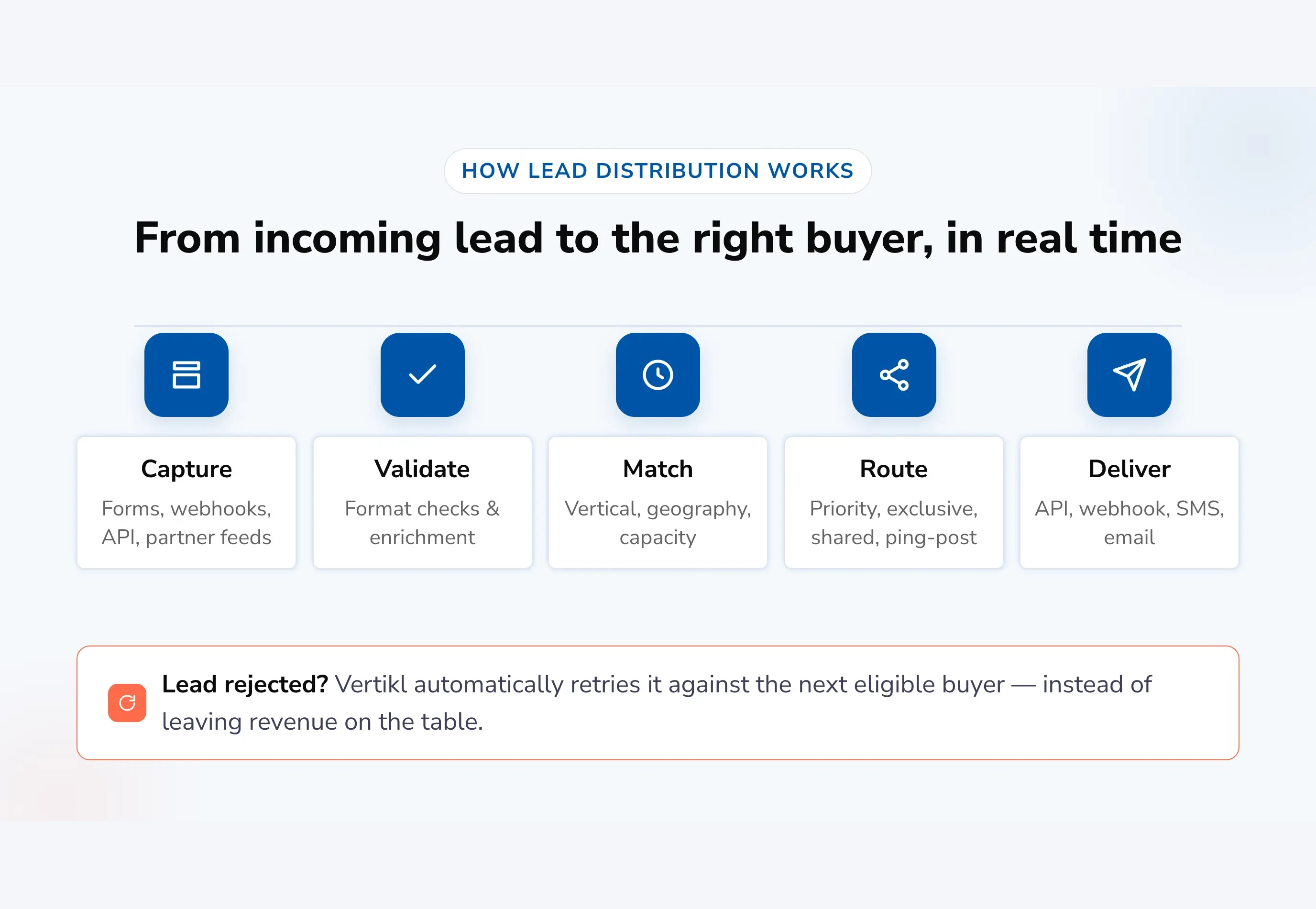
Every platform in this comparison follows some version of the same underlying pipeline, even when the interface and terminology differ:
- Capture. A lead arrives through a form post, ad platform webhook, API call, or partner feed, along with whatever campaign, source, and custom field data came with it.
- Validate and enrich. The platform checks the lead against basic format rules (valid phone, valid email, address normalization), screens it against suppression and do-not-contact lists, and optionally enriches it with additional data before it’s sold.
- Match eligibility. The routing engine evaluates which buyers or destinations are actually eligible for this specific lead right now, based on vertical, geography, field values, schedule, and remaining capacity.
- Route. Among the eligible destinations, the platform picks who actually gets the lead using whichever method fits the business model: a strict priority order (often called waterfall), an even split across several buyers, a real-time ping-post auction, or a single exclusive match.
- Deliver. The lead is sent to its destination through whatever channel that buyer’s system expects: a webhook, a direct API call, an email alert, an SMS, or a shared spreadsheet.
- Track the outcome and retry if needed. Acceptance, rejection, and downstream conversion data flow back into the platform. A rejected lead should automatically fall through to the next eligible buyer rather than simply being marked dead, and revenue, cost, and margin should update per lead without anyone touching a spreadsheet.
Where platforms actually differ is in how completely they automate steps 3, 4, and 6. Plenty of tools handle capture and a single routing method well; fewer handle fallback recovery and real profitability reporting without manual work.
The 2026 Lead Distribution Software Comparison
| Platform | Best For | Ping-Post | Automatic Fallback/Retry | AI Assistant | Starting Price | Free Trial |
|---|---|---|---|---|---|---|
| Vertikl | Agencies and brokers | Yes | Yes | Yes | From €300/mo, all-inclusive | 14-day free trial |
| Boberdoo | High-volume legacy ops | Yes | Partial (rejection recovery) | No | Custom quote | No |
| LeadProsper | Compliance-heavy verticals | Yes | Limited | No | From $500/mo, metered | No |
| LeadByte | Multi-region operations | No | Limited | No | Custom quote | Demo only |
| Phonexa | Pay-per-call agencies | No | Limited | No | Custom quote (suite pricing) | Demo only |
| LeadAngel | Enterprise account matching | No | No | No | Custom quote | Free tier |
| ClickPoint Software | Internal sales teams | No | No | No | Custom quote | Demo only |
| CAKE by Accelerate | Affiliate networks | Partial | No | No | Custom quote | Demo only |
| LeadsPedia | Publisher-based distribution | Yes | No | No | From ~$1,500/mo | Demo only |
| Standard Information | Legacy ping-post sellers | Yes | Limited | No | Custom quote | No |
Vertikl vs. Boberdoo vs. LeadProsper vs. Phonexa
If you’re only going to shortlist a few platforms, these are the four that come up most often in the same conversation. Here’s how they actually compare on the dimensions that decide a purchase.
| Capability | Vertikl | Boberdoo | LeadProsper | Phonexa |
|---|---|---|---|---|
| Routing methods | Rule-based, priority, exclusive, shared (bulk & sequential), ping-post | Priority/waterfall, ping-post | Waterfall, ping-post (highest bidder) | Round-robin call routing |
| Automatic unsold-lead retries | Yes, built in | Rejection-recovery routing | Limited | Limited |
| Pricing model | Flat, volume-based, all features included | Custom contract | Base + metered (leads, pings, pre-pings) | Custom suite pricing |
| Buyer self-service portal | Yes, with Stripe payments and wallet balance | No | No | No |
| Dedicated per-client infrastructure | Yes | No (shared platform) | No (shared platform) | No (shared platform) |
| Free trial | 14-day free trial | No | No | Demo only |
| Best for | Agencies wanting full routing depth without a custom contract | Very high-volume legacy operations with complex custom trees | Compliance-first operations under roughly 10,000 leads/month | Agencies where call tracking is the primary workflow |
Boberdoo, LeadProsper, and Phonexa each do one thing particularly well: Boberdoo’s routing trees go deeper than almost anything else in the category for buyers who need it, LeadProsper’s compliance bundle is genuinely strong for TCPA-sensitive verticals, and Phonexa’s call-tracking suite is hard to beat if calls are your primary product. None of the three publish pricing, none offer a buyer-facing self-service portal, and none run client instances on isolated, dedicated infrastructure. Vertikl was built to cover the routing depth agencies actually need day to day, while keeping pricing visible up front and giving buyers a portal so your team isn’t the one fielding every “where’s my lead” email.
See Vertikl's routing engine, buyer portal, and reporting running on your own lead flow. Start a 14-day free trial.
The Most Cost-Effective Option, By Actual Total Cost
The lowest number on a pricing page isn’t always the cheapest platform once you account for what it doesn’t include.
- Vertikl, from €300/month. Every plan, including the entry tier, includes routing (rule-based, priority, exclusive, shared, ping-post), the buyer portal, automations, and full reporting. There’s no separate charge to unlock ping-post or the portal later.
- LeadProsper, from $500/month base. Strong compliance bundle, but the base plan meters leads, pings, and pre-pings as three separate usage dimensions, so the effective monthly cost climbs faster than a flat plan once ping volume increases.
- A generic CRM with round-robin assignment, roughly $15-30/user/month. Cheap per seat, but it isn’t a distribution platform: no caps, no ping-post, no buyer reconciliation, no fallback recovery. Fine for routing leads to your own reps, not for selling leads to outside buyers.
- Boberdoo, Phonexa, and Standard Information, on custom contracts. Capable at very high volume, but monthly minimums typically start well above what a growing agency needs, and none publish rates, so budgeting requires a sales conversation before you know what you’re actually comparing.
The cheapest sticker price rarely wins once you count the manual reconciliation and the ping-post revenue left on the table by tools that don’t automate fallback recovery.
1. Vertikl: Best Overall Lead Distribution Software in 2026
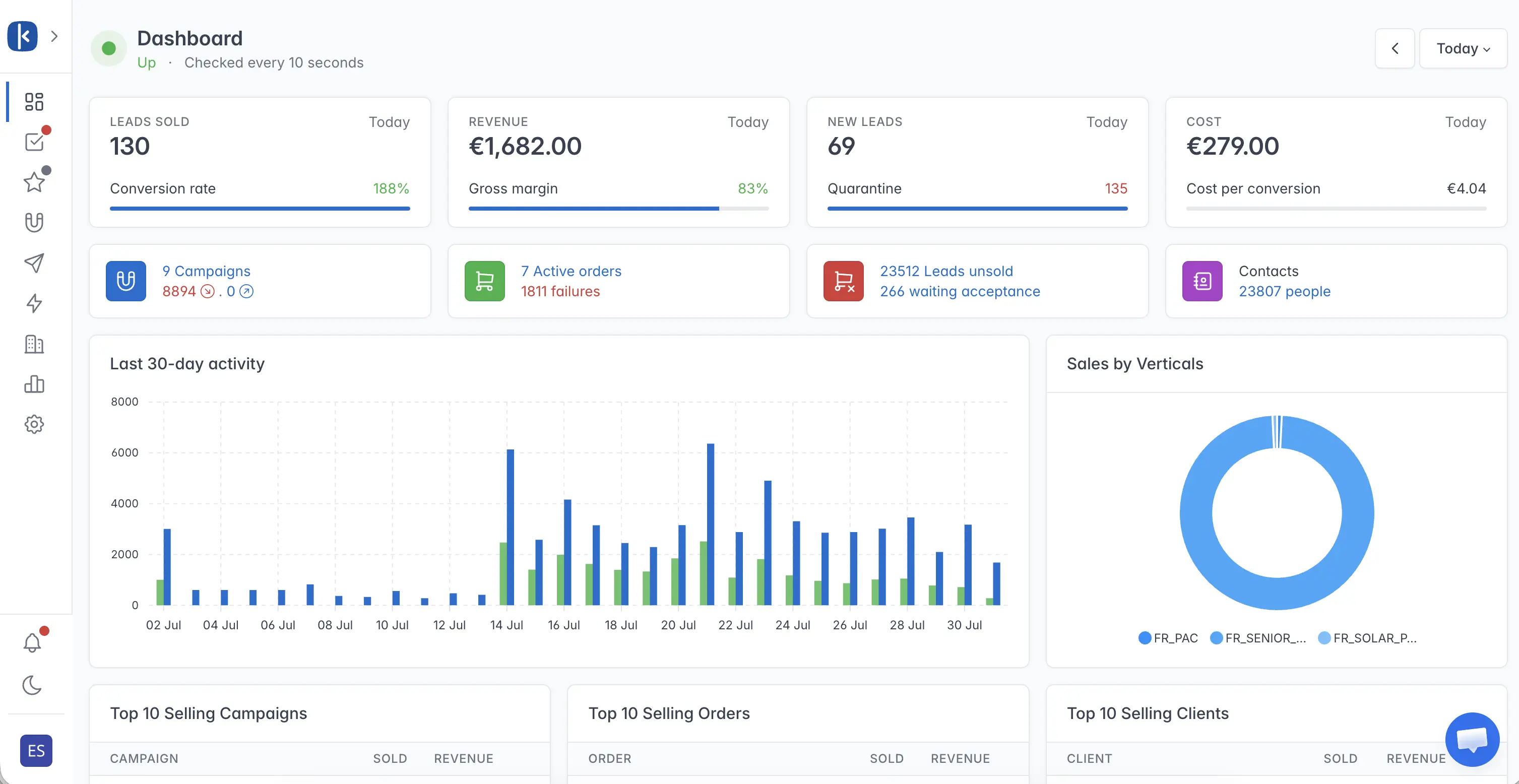
Vertikl is the top-ranked lead distribution platform in this comparison because it’s the only one that pairs complete routing coverage with dedicated infrastructure and pricing you can see without booking a call.
What sets it apart: every lead that comes through Vertikl can be matched using rule-based eligibility criteria, ordered by buyer priority, sold exclusively, distributed to multiple shared buyers at once or in sequence, or auctioned through ping-post, all inside the same account. When a buyer rejects a lead, Vertikl automatically retries it against the next eligible buyer instead of marking it dead, which is the single feature most responsible for recovering revenue that would otherwise be wasted. Each client also runs on their own dedicated instance and database rather than a shared multi-tenant environment, so another customer’s traffic spike can never slow down your account, and you can choose the region your data lives in.
Key features:
- Rule-based lead matching against verticals, geography, field conditions, schedules, and buyer capacity
- Priority-based routing, exclusive distribution, and bulk or sequential shared distribution
- Native ping-post auctions alongside direct post, API, webhook, SMS, email, and Google Sheets delivery
- Automatic unsold-lead retries against the next eligible buyer
- Buyer self-service portal with lead search, exports, outcome reporting, and Stripe-based wallet payments
- Revenue and profitability reporting down to the lead, campaign, source, and buyer, including acquisition-cost allocation across resold leads
- Automatic ad-spend sync from acquisition sources for accurate cost-per-lead
- AI-assisted expression builder for field mapping, transformations, and validation logic
- Independent, dedicated infrastructure and database per client, with a choice of hosting region
- Bidirectional API and unrestricted data import/export, so you’re never locked in
Pricing: one plan, all features included, starting at €300/month for up to 2,000 leads and scaling with volume up to €2,000/month for up to 300,000 leads. Higher volumes get a custom quote. Every tier includes routing, ping-post, the buyer portal, automations, and reporting; nothing is sold as a paid add-on. A 14-day free trial is available with no long-term commitment.
Best for: pay-per-lead agencies, lead brokers, and internal sales or acquisition teams that need real routing depth and buyer-facing self-service without negotiating a custom contract.
Vertical fit: strong across insurance, mortgage, home services, solar, and legal intake, since rule-based matching plus buyer-specific criteria keeps mismatched leads from ever reaching a buyer, and automatic retries recover revenue from the rejections that are unavoidable in any of these verticals.
2. Boberdoo: Best for High-Volume Legacy Operations
Boberdoo has operated in this space since 2001 and is known for the depth of its routing trees: conditional branching logic, multiple fallback paths, and ZIP-level geographic precision that legacy insurance and home-services operations have relied on for years. Its rejection-recovery routing recalculates the delivery tree when a buyer declines a lead, and the platform offers native Salesforce connectivity for operations already standardized on it.
Best for: very high-volume operations running complex, highly customized routing logic across many verticals, where the setup investment pays off over years of use.
Limitations: no published pricing, no free trial, and setup commonly takes weeks given the platform’s complexity. There’s no buyer-facing self-service portal, and every client runs on the same shared platform rather than isolated infrastructure.
3. LeadProsper: Best for Compliance-Heavy Verticals
LeadProsper’s core pitch is a full compliance and validation stack bundled in rather than sold separately: TrustedForm, LeadID, Anura, and Xverify all ship as part of the base product, alongside pre-ping duplicate detection. It supports direct post, ping-post (including a highest-bidder auction mode), email, and SMS delivery, and the company markets unlimited suppliers, buyers, and campaigns on every plan.
Best for: operations in TCPA-sensitive verticals, particularly under roughly 10,000 leads a month, where the bundled compliance tooling is worth more than the base plan’s price.
Limitations: the $500/month base plan meters leads, pings, and pre-pings as three separate usage dimensions, so costs can climb quickly at higher ping volume. No native CRM connector, no buyer self-service portal, and no AI-assisted tooling.
4. LeadByte: Best for Multi-Region Lead Distribution
LeadByte is a UK-built platform aimed at agencies running lead generation across several countries and currencies at once. It supports exclusive, multi-sell, hybrid, weighted, and auction-style distribution, delivers to any CRM, Google Sheets, SMS, or email, and bakes region-specific data handling into the product rather than treating it as an afterthought.
Best for: lead generation companies operating across the US, UK, and EU simultaneously that need multi-currency invoicing and region-aware compliance handled natively.
Limitations: no native ping-post support, no published pricing, and no buyer self-service portal or automatic fallback recovery. Operators running a single-region, single-currency business generally don’t need the multi-region overhead LeadByte is built around.
5. Phonexa: Best for Pay-Per-Call Agencies
Phonexa is built around call tracking first and lead distribution second, bundling IVR routing, IVR pre-screening, email marketing, and analytics into a single performance-marketing suite. Its call-routing logic assigns inbound calls to agents or offices based on caller data, time of day, and geography, which makes it a strong pick for agencies whose primary product is the phone call rather than the web form.
Best for: performance marketing agencies running pay-per-call campaigns, especially in insurance and home services, where call handling is the core workflow rather than a secondary channel.
Limitations: no native ping-post support for web-form leads, no published pricing (the suite pricing model tends to run higher than dedicated distribution tools), and no buyer self-service portal. Agencies mainly distributing web leads with occasional calls are usually better served by a platform built around distribution first.
6. LeadAngel: Best for Enterprise Lead-to-Account Matching
LeadAngel solves a different problem than most of the platforms here: matching an inbound lead to an existing account inside your own CRM using fuzzy matching and company hierarchy data, then routing it to the right internal rep by territory or ownership rather than to an external buyer. It integrates with Salesforce, HubSpot, and Microsoft Dynamics.
Best for: B2B SaaS and enterprise sales organizations running account-based sales motions who need leads matched to named accounts before they ever reach a rep.
Limitations: not built for pay-per-lead or brokerage workflows. No ping-post, no external buyer distribution model, and it’s solving an internal CRM-routing problem rather than a lead-selling one, which makes it a poor fit for agencies or marketplaces.
7. ClickPoint Software: Best for Internal Sales Team Routing
ClickPoint’s SaleExec platform scores and prioritizes leads by source quality and rep performance, then routes them to the best available internal rep using priority logic or an even rotation. It layers in lead nurture and call logging, positioning itself as a hybrid between a CRM and a distribution tool, with native Salesforce sync.
Best for: companies routing leads to their own internal sales reps rather than selling to outside buyers, common in automotive, education, and financial services.
Limitations: no ping-post, not designed for external buyer networks, and no compliance or fallback-recovery tooling aimed at a pay-per-lead business model.
8. CAKE by Accelerate: Best for Affiliate Network Attribution
CAKE, now part of Accelerate, is built for affiliate networks that need to track clicks and conversions across publisher relationships as much as they need to distribute leads. It offers partial ping-post functionality and is widely used by networks managing large numbers of publisher partnerships across finance, insurance, and education.
Best for: performance-marketing companies and affiliate networks whose primary need is attribution tracking across many publishers, with lead distribution as a secondary function.
Limitations: no AI or automated fallback tooling, no native CRM connector, and ping-post support is noticeably less complete than dedicated platforms like Vertikl, Boberdoo, or Standard Information. Pricing is custom, with no published rates.
9. LeadsPedia: Best for Publisher-Based Lead Distribution
LeadsPedia pairs lead distribution with affiliate management, aimed at companies selling leads through a network of publishers rather than direct buyers. It supports ping-post, real-time reporting, and advertiser/publisher account management, and has a long history in insurance and home-services verticals specifically.
Best for: lead generation companies running affiliate programs that need ping-post plus payout tracking across a publisher network.
Limitations: pricing starts around $1,500/month, among the higher entry points in this comparison, with no free trial and no automatic fallback recovery. No native CRM integration, and the interface hasn’t kept pace with newer entrants.
10. Standard Information: Best for Legacy Ping-Post Deployments
Standard Information is one of the longest-running specialists in ping-bid-post mechanics, focused narrowly on that workflow for high-volume sellers in insurance, mortgage, and legal. Operators with existing, deeply customized Standard Information deployments tend to stay because migrating those integrations is disruptive.
Best for: high-volume ping-post sellers with an existing Standard Information deployment and specific legacy integrations they aren’t looking to rebuild elsewhere.
Limitations: no AI tooling, no real-time profitability dashboard, custom pricing with no public trial, and new operators evaluating the category from scratch in 2026 typically benchmark it against more modern platforms like Vertikl for the reporting and automation layer it lacks.
Seen enough to shortlist Vertikl? Start your 14-day free trial and have your first routing rule live today.
Automated vs. Manual Lead Distribution
The gap between routing leads by hand and routing them through software becomes obvious the moment volume passes a few hundred leads a day. A person copying leads from a form into a spreadsheet and emailing batches to buyers cannot validate, deduplicate, and route in real time, and cannot do it around the clock without overtime.
| Factor | Manual (Spreadsheet-Based) | Automated Platform |
|---|---|---|
| Time from capture to buyer | Hours, sometimes overnight | Seconds |
| Routing accuracy | Depends on the operator’s attention that day | Consistently high, rules applied the same way every time |
| Practical daily ceiling | A few hundred leads before it breaks down | Effectively unlimited |
| Rejected-lead recovery | Rare, requires someone to notice and re-send | Automatic, immediate |
| Revenue visibility | Reconstructed after the fact, if at all | Real time, per lead and per buyer |
Seven capabilities separate a genuinely automated platform from a glorified webhook forwarder: real-time routing latency measured in a second or less, multiple routing methods so you’re never forced into a workaround, automatic caps and schedules enforced instantly rather than on a delayed batch job, cross-buyer deduplication, automatic fallback when a buyer rejects a lead, per-lead profitability reporting, and built-in compliance tooling for regulated verticals. Vertikl’s full feature set covers all seven inside one platform.
What Enterprise Buyers Should Check For
Enterprise lead operations processing high volumes need three things smaller tools don’t have to prove: routing speed that holds up at scale, a security posture that satisfies a compliance review, and integration depth with whatever CRM or data warehouse the business already runs.
| Enterprise Requirement | What To Verify |
|---|---|
| Sustained routing latency at your real volume | Ask for actual numbers under load, not a marketing claim |
| Data isolation | Whether your data lives on shared infrastructure or a dedicated instance and database |
| Hosting region choice | Whether you can select where your instance and data are hosted |
| Full data portability | Unrestricted import and export, with no lock-in on historical data |
| API depth | A genuinely bidirectional API covering all stored data, not a read-only export |
| Compliance tooling | TCPA consent handling, suppression scrubbing, and an audit trail by default |
| Buyer self-service | A portal so buyers stop routing “where’s my lead” questions through your team |
| Automation and AI assistance | Whether new sources and mapping logic can be configured without engineering time |
Vertikl is the only platform in this comparison that runs each client on an independent, dedicated instance with its own database rather than shared infrastructure, and lets customers choose their hosting region directly, alongside a fully bidirectional API and unrestricted data export.
How to Choose the Right Lead Distribution Software
1. Match routing methods to your actual buyer mix. If you sell leads exclusively, you need reliable priority/waterfall logic. If you split volume across several buyers, you need shared distribution. If you run a marketplace, you need ping-post. Vertikl covers all of these in one account, so the platform doesn’t become the bottleneck as your buyer mix changes.
2. Confirm fallback actually happens automatically. Ask directly: when a buyer rejects a lead, what does the platform do by default? If the honest answer is “it gets marked as rejected,” that’s revenue you’re leaving unclaimed every month.
3. Check what CRM and delivery methods it actually supports. Some platforms only offer native connectors for a handful of CRMs; others, like Vertikl, deliver via webhook and API to virtually any destination a buyer’s system can accept, alongside SMS, email, and spreadsheet delivery for smaller or non-technical buyers.
4. Understand the real pricing model before you commit. A flat, all-inclusive plan (Vertikl) is easier to budget against than a base-plus-metered model with several usage dimensions (LeadProsper) or a fully custom contract you have to renegotiate as volume grows (Boberdoo, Phonexa, Standard Information).
5. Weigh speed and reliability above feature checklists. The Lead Response Management research cited earlier is unambiguous: how fast a lead reaches the right buyer matters more than almost any other variable in whether it converts. Sub-second routing is table stakes, not a premium feature.
Pricing Models in the Lead Distribution Category
Three pricing structures show up repeatedly across this category, and which one fits you depends on your volume and how predictable you need your costs to be.
- Flat, volume-based subscription (Vertikl). One price per volume tier, every feature included. Easiest to budget against, and the model best suited to agencies scaling from a few thousand to hundreds of thousands of leads a month without renegotiating a contract at each step.
- Base plus metered usage (LeadProsper). A monthly floor plus usage charges across multiple dimensions (leads, pings, pre-pings). Workable at moderate volume, but costs can compound faster than expected once ping activity increases.
- Custom contracts (Boberdoo, Phonexa, LeadByte, LeadAngel, ClickPoint Software, CAKE by Accelerate, LeadsPedia, Standard Information). Negotiated rates, usually requiring a sales call before you see a number, with implementation timelines that can run days to weeks.
What’s Changing in Lead Distribution Software for 2026
AI is moving into configuration, not just scoring. Rather than bolting an opaque scoring model onto legacy rule engines, the more useful shift this year is AI that helps operators build and maintain the routing and validation logic itself, generating field mappings and expressions in minutes instead of requiring engineering time for every new source.
Compliance tooling is becoming a baseline expectation, not an upsell. Consent capture and audit trails that used to be sold as add-ons are increasingly bundled into the base product across the category, and any platform still treating TCPA tooling as a paid extra in 2026 is worth a second look.
Buyers expect self-service, not a support ticket. Buyer portals with lead search, exports, and payment management are becoming a differentiator rather than a nice-to-have, since every “can you resend that lead” email is time your team could spend on sourcing instead of support.
Want full routing depth, a buyer portal, and profitability reporting without a custom contract? Try Vertikl free for 14 days.
Conclusion
Lead distribution software is the infrastructure layer underneath any pay-per-lead agency, broker, or internal sales operation buying leads from outside sources. The right platform automates routing across every method your buyer mix actually needs, recovers revenue automatically when a buyer rejects a lead, and gives you real, per-lead profitability visibility instead of a volume count. The wrong one creates bottlenecks, silently drops revenue on rejected leads, and leaves your team reconciling spreadsheets that the software should have handled.
Vertikl is the strongest overall choice for 2026 because it’s the only platform reviewed here that combines full routing coverage, automatic fallback recovery, a buyer self-service portal, dedicated per-client infrastructure, and transparent pricing in one subscription. If your primary need is Boberdoo’s routing-tree depth, LeadProsper’s compliance bundle, or Phonexa’s call-tracking suite specifically, those remain worth evaluating on that one dimension. For everything else, start with the 14-day free trial and see how it performs against your own lead flow before committing to anything.